


Samsung, SK Hynix mega South Korea chips gamble tests optimism of AI cycle
Samsung, SK Hynix mega South Korea chips gamble tests optimism of AI cycle

By Hyunjoo Jin and Heekyong YangTue, June 30, 2026 at 8:36 AM UTC
0
By Hyunjoo Jin and Heekyong Yang
SEOUL, June 30 (Reuters) - Samsung Electronics and SK Hynix are making one of the biggest bets yet on the artificial intelligence boom with investments worth hundreds of billions of dollars, but the planned capacity buildout is stoking fears of a painful reckoning if AI spending cools.
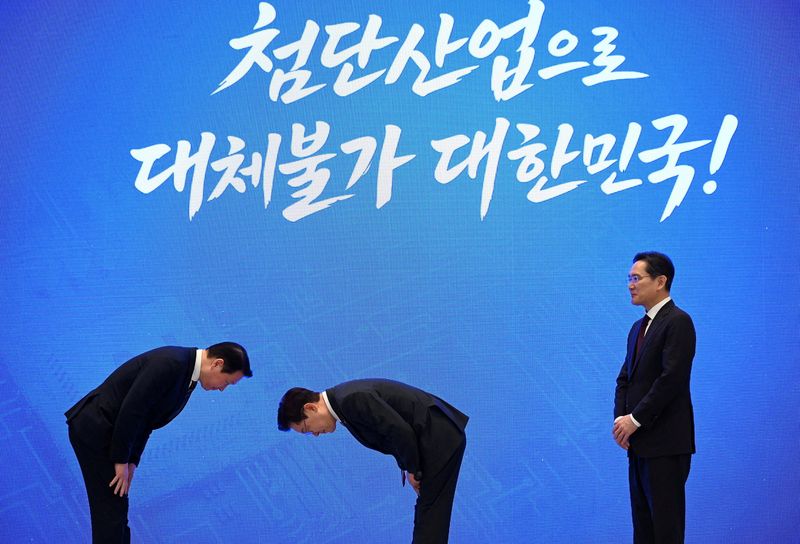
The tech giants won praise - and a deep bow - from President Lee Jae Myung after throwing their weight behind the government's semiconductor push, in an apparent departure from a previously restrained approach to capacity expansion shaped by decades of painful boom-and-bust cycles in the memory industry.
Under the plan, the government hopes South Korea can double its memory chip production capacity within five years. Samsung and SK Hynix will also accelerate construction of fabs in the existing Yongin semiconductor cluster, shortening the 7-12 year timelines and bringing additional capacity online sooner.
Together, the world's two biggest memory chipmakers pledged 3,200 trillion won ($2.07 trillion) of investment, encompassing a new 800 trillion won chip cluster in the country's southwest as well as previously announced projects.
South Korea is emerging as a major winner from the surge in global AI investment, driven by Samsung Electronics and SK Hynix's commanding position in high-bandwidth memory (HBM) chips essential to advanced AI processors.
The announcement comes as customers ranging from AI hyperscalers to electronics makers such as Apple press for more memory chips amid a global shortage. But analysts note that chip plants take years to build and ramp up, meaning much of the new capacity will not arrive until well into the next decade.
"We see memory pricing remaining a function of demand and supply, and accelerating capex over the next decade further increases the risk of an oversupply longer term," said Morningstar analyst Jing Jie Yu.
The memory chip boom remains reliant on whether AI hyperscalers would keep expanding at the current rate, he added.
Lee Jong-ho, a professor at Seoul National University's Department of Electrical and Computer Engineering, said the investments appeared to have been pushed through too quickly.
"It is the kind of investment that could determine a company's future," he said.
"No one knows what the situation will look like three years from now. We need to respond quickly while demand is strong, but after that, demand is uncertain and decisions should be made cautiously."
The soaring profitability of Samsung and SK Hynix's memory businesses is a relatively recent phenomenon, driven by the global AI boom and an acute memory-chip shortage that has nearly doubled chip prices in the first quarter alone.
Past downturns in chip prices have badly hit the companies, causing SK Hynix to flirt with bankruptcy in 2001 and driving both firms to post big losses in 2023.
But in recent months, as the AI wave swelled, ruling party lawmakers and government officials began floating the idea of relocating some of the chip factories to the country's southwest, their key support base largely bypassed during the country's industrial rise.
As recently as two months ago, SK Hynix Chairman Chey Tae-won expressed scepticism when asked by a lawmaker about plans for chip factories in the southwest.
Advertisement
"I'm not sure semiconductors are necessarily the field you have to go into," he said.
Neither company explained what prompted the change of heart.
Both Samsung and SK Hynix said they would now be able to speed up construction in Yongin as the government had pledged to accelerate approvals, as part of efforts to meet surging demand.
"Investing in other regions could be a way of hedging the uncertainty surrounding the Yongin semiconductor cluster," said CW Chung, an analyst at Nomura.
Still, analysts said they believed the companies would learn from past cycles.
"A downturn in the memory industry is clearly a risk to the plan," CLSA senior analyst Sanjeev Rana said.
But "memory producers retain the flexibility to adjust their investment pace if signs of excess capacity emerge."
Samsung's plan envisages investing 2,100 trillion won in chip production through 2040, though it noted spending could be adjusted for market conditions and business needs.
In 2024, Samsung halted construction of its P5 chip plant in Pyeongtaek, south of Seoul, for nearly two years amid a market downturn before resuming work late last year.
During Monday's presentation attended by President Lee, SK Hynix's Chey said the company would monitor demand conditions as it determined the scale of investment but added that currently it was still difficult to fully address the supply shortage.
For the government, however, maintaining momentum is a strategic priority.
South Korean presidential chief of staff Kang Hoon-sik on Monday said the government would fast-track approvals and seek to complete the chip cluster before Lee's term ends in 2030.
Koh Taebong, head of research at iM Securities, said he viewed the move as a bet in the right direction for South Korea as the world enters the era of AI-driven transformation.
"Yesterday's message was that South Korea is serious about becoming one of the world's top three AI powers. This isn't just rhetoric - the government is committing to spending real money to make it happen."
(Reporting by Hyunjoo Jin, Heekyong Yang, Additional reporting by Heejin Kim and Joyce Lee; Editing by Brenda Goh and Shri Navaratnam)
Source: “AOL Money”
